I’ve been noticing a strange tension in how people talk about AI startups right now.
The optimism is real. AI has made it easier than ever for a small team to build something useful. A few people can prototype, design, code, test, and launch at a speed that would have felt absurd a few years ago. Some of the largest AI executives have talked about the possibility of one-person or very small-team billion-dollar companies, and that idea has clearly entered the bloodstream of Silicon Valley.
That is a genuinely exciting shift. Company-building feels less gated than it used to. A smart person with taste, persistence, and access to the right tools can do a lot more with a lot less.
But the part that feels missing is the economics underneath.
A lot of the current excitement treats access to intelligence as if it means independence from the companies providing it. You can call the API, build the workflow, launch the product, and suddenly it feels like the old constraints have disappeared.
I don’t think they have disappeared. They have moved downward into the infrastructure.
Most AI application companies today are not creating intelligence from scratch. They are renting it. The user sees the app, the interface, the workflow, the agent. Underneath that, there is usually a model call, a token meter, a rate limit, a cost structure, and a data center somewhere turning electricity into output.
Tokens are not magic. They are priced units of compute.
That changes how I think about the whole space.
People talk about AI like software, but the economics behave much more like infrastructure. As usage scales, compute demand follows. As products become more agentic, the token load can grow quickly. If a model performs better by spending more time thinking, that thinking has to be paid for somewhere.
This is why a startup can have a beautiful product and still be structurally exposed. If its cost of goods sold depends on another company’s model pricing, the business has to keep answering a hard question: how much margin does the intelligence provider leave me?
That does not make the startup bad. It just makes the economics more fragile than the “small team builds massive company” story sometimes suggests.
You can see versions of this tension in developer tools. A model-agnostic product can feel very strong from a user experience standpoint, especially when it gives developers access to multiple frontier models inside one workflow. But once the product depends heavily on models it does not own, token economics become part of product strategy whether anyone wants them to or not.
This is a broader pattern, not a comment on any single company.
Application companies can absolutely win on product, taste, workflow, distribution, and customer understanding. Those things matter enormously. But if the product is powered by rented intelligence, some part of the economics keeps flowing back to the infrastructure layer.
That is where the narrative gets tricky.
The same executives who talk about tiny teams building giant companies are often running the companies whose models and infrastructure those teams depend on. The prediction may be true. AI really may create billion-dollar companies with very few employees.
But it is also a convenient story for the infrastructure providers.
At the surface, AI feels decentralizing because more small teams can now do work that used to require large organizations. Underneath, the scarce resource is concentrating around the companies that can secure GPUs, power, data centers, capital, and talent.
So I don’t think the right question is whether startups or labs win.
The better question is what part of the stack captures the economics when intelligence becomes a utility.
If models become cheap and interchangeable, application companies capture more value. If frontier capability remains scarce and expensive, the labs remain structurally powerful. If open-source models become strong enough and cheap enough to run, the equation changes again. If compute supply expands dramatically, the whole cost curve shifts.
But today, the system still runs through compute.
That is why I’m skeptical of the cleanest version of the small-team utopia. Small teams absolutely can build massive companies. But many of those companies will still be building on a cost structure they do not control.
The AI boom makes creation feel lighter. It reduces the friction between idea and product. It lets one person feel like a team.
The physical layer underneath is much heavier.
Data centers, power, GPUs, inference, and capital are the ground beneath the entire system.
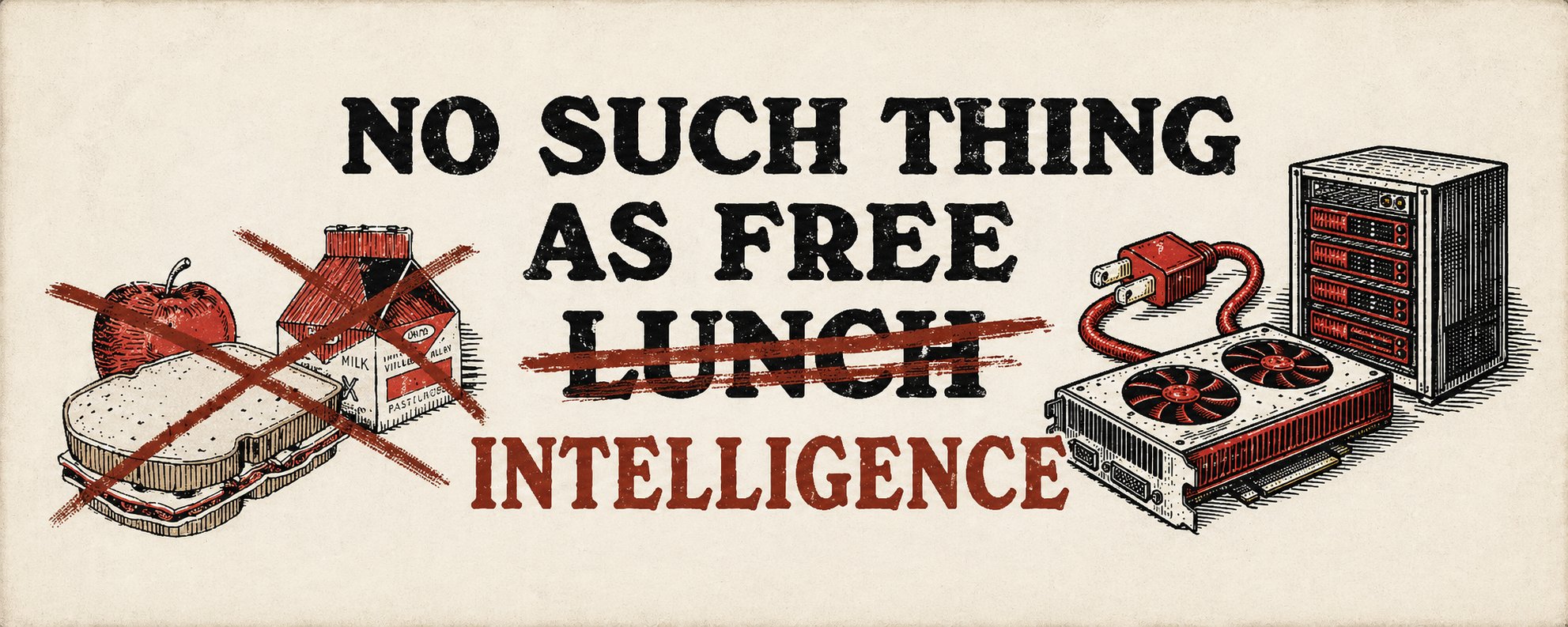
There is no such thing as a free lunch. And in AI, there is no such thing as free intelligence.