Going to the Mars sounds reckless.
Impractical. Obscenely expensive. A distraction from poverty, wars, pollution. Basically an attempt to escape everything unresolved here on Earth.
“Shouldn’t we fix our own planet first?”
Yes, but it is not that simple.
History suggests something counterintuitive: the moments when humanity reaches furthest outward are often the ones that reshape life here the most.
The frontier is not an escape from our problems. It is a catalyst for solving them.
Mars is not about leaving Earth, it is about saving it.
What Big Goals Do
In 1969, we put humans on the Moon. If you zoom out for a second, the timeline is absurd. The Wright brothers flew in 1903. Two world wars happened. And then, within a single lifetime, humans were walking on another celestial body.
That does not happen because a society is casually optimizing. It happens because it reorganizes itself around an idea that feels slightly insane.
At its peak in the mid 1960s, NASA’s budget was over 4 percent of the entire U.S. federal budget. Today, it is closer to 0.4 percent. An order of magnitude difference.
Clearly, space was not a side project. It absorbed talent, capital, attention. When that much energy is pointed at one goal, breakthroughs become almost inevitable and willed into existence.
And these breakthroughs were not just rockets. The Apollo era accelerated computing, materials science, systems engineering, satellite infrastructure. You do not get incremental progress when the target is the Moon. You end up rewriting whole stacks.
But the part I find more interesting is not even the technology. It is what it did psychologically.
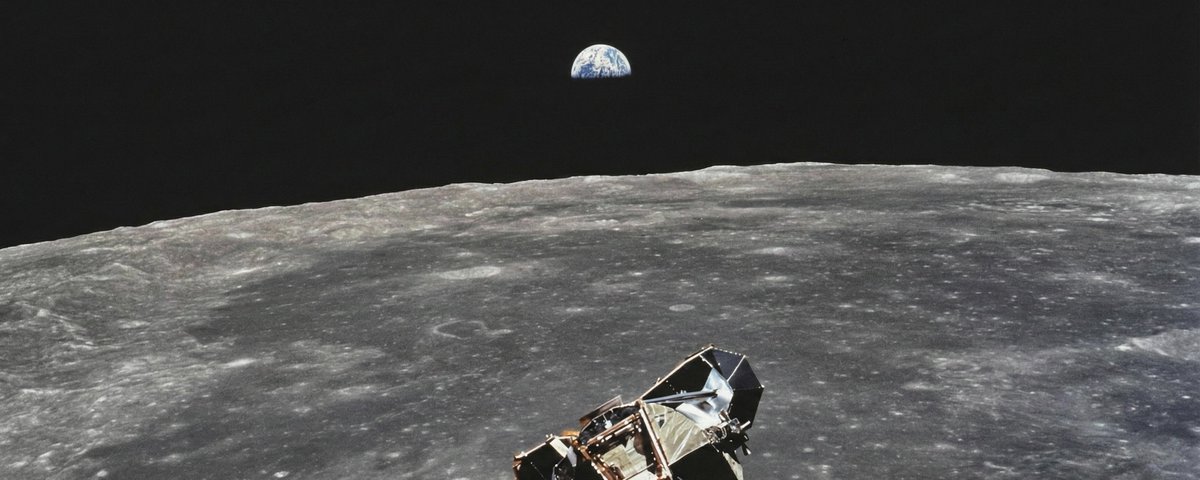
When Apollo 8 astronauts captured Earth rising over the Moon’s horizon in 1968, that blue sphere hanging in a black void changed how we saw ourselves. The environmental movement drew real momentum from that image. Borders looked smaller. Fragility looked more obvious. Zooming outward made us look inward differently.
The Familiar Pattern
Today, we are in another kind of race. Not U.S. versus the Soviet Union per-say, but labs versus labs. Companies versus companies. Research groups with the world's smartest scientists racing to build increasingly capable machine intelligence.
One could ask:
“Why are we building systems that can write, reason, generate code, and conduct research when the world already feels unstable?”
It is the same type of criticism.
But aiming at something as ambitious as creating software that can think alongside us forces a civilization to level up. We are rebuilding compute infrastructure from scratch. Designing new chips optimized for parallel reasoning. Scaling data centers to levels that rival national infrastructure projects. Entire industries are reorganizing around automation of cognition.
Even if timelines are wrong or hype cycles overshoot, the attempt itself reshapes everything around it.
Ambitious frontiers distort trajectories.
The Counterintuitive Part
The more serious you get about surviving somewhere like Mars, the more you are forced to master sustainability, energy efficiency, and closed loop systems. The kinds of systems that matter deeply here.
The more serious you get about building machines that can reason and create, the more you are forced to confront governance, coordination, labor transitions, and long term safety.
The projects that look the most futuristic end up dragging present day civilization into deeper maturity.
There is also a perspective shift that is harder to quantify but just as real. If we might be the only conscious species in this galaxy, a single flicker of awareness in an enormous universe, then expanding our reach is not escapism. It is curiosity scaling outward. It is intelligence trying to understand more of the environment it woke up inside.
That may sound grand. But so did flying 30,000 feet above the ground at 500 miles per hour in a metal tube.
The Real Risk
The bigger risk to me is not that we aim too high. It is that we shrink our horizon. That we decide the safest path is to stay bounded, optimize what already exists, and stop attempting things that require generational commitment.
Civilizations that feel alive usually have a frontier. Sometimes it is geographic. Sometimes it is scientific. Sometimes it is computational. The frontier does not have to be reached next year. It just has to exist.
Space is not about leaving Earth.
It is about stretching what we are capable of here.
And that stretching changes who we become.